Mandatory by 2027! Navigating the Critical Tech Overhaul and Survival in the EV Charging Industry under AFIR
2025年12月22日
Deep Dive into CTEP (California Type Evaluation Program):Your Ticket to the Californian EV Charging Market
2026年3月13日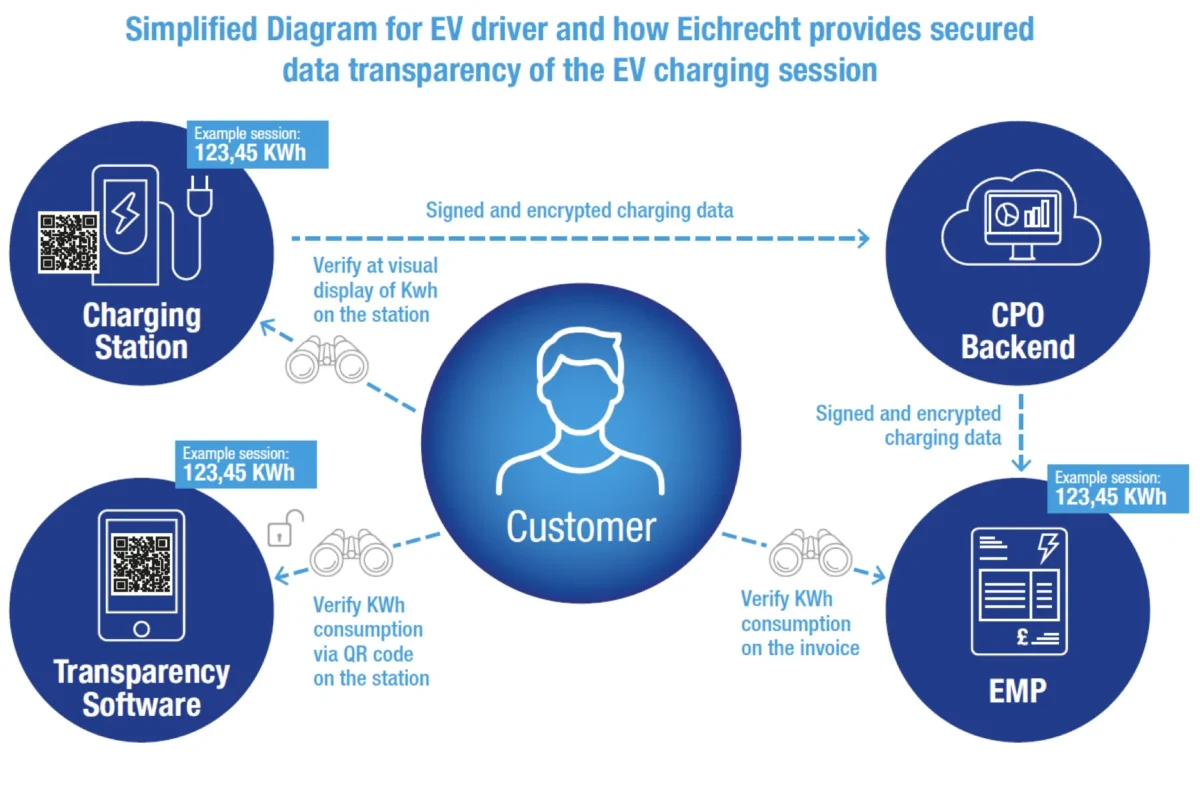
Deep Dive into Eichrecht (German Calibration Law):
Ensuring Transparent and Fair EV Charging
As the electric vehicle (EV) industry experiences rapid transformation, fairness and transparency in how drivers are billed for charging are becoming increasingly important. Eichrecht, a robust German regulation, was introduced to eliminate hidden fees and standardize charging practices so that the EV charging network operates much like a traditional petrol station—customers only pay for the exact kilowatt-hours (kWh) they consume.
What is Eichrecht?
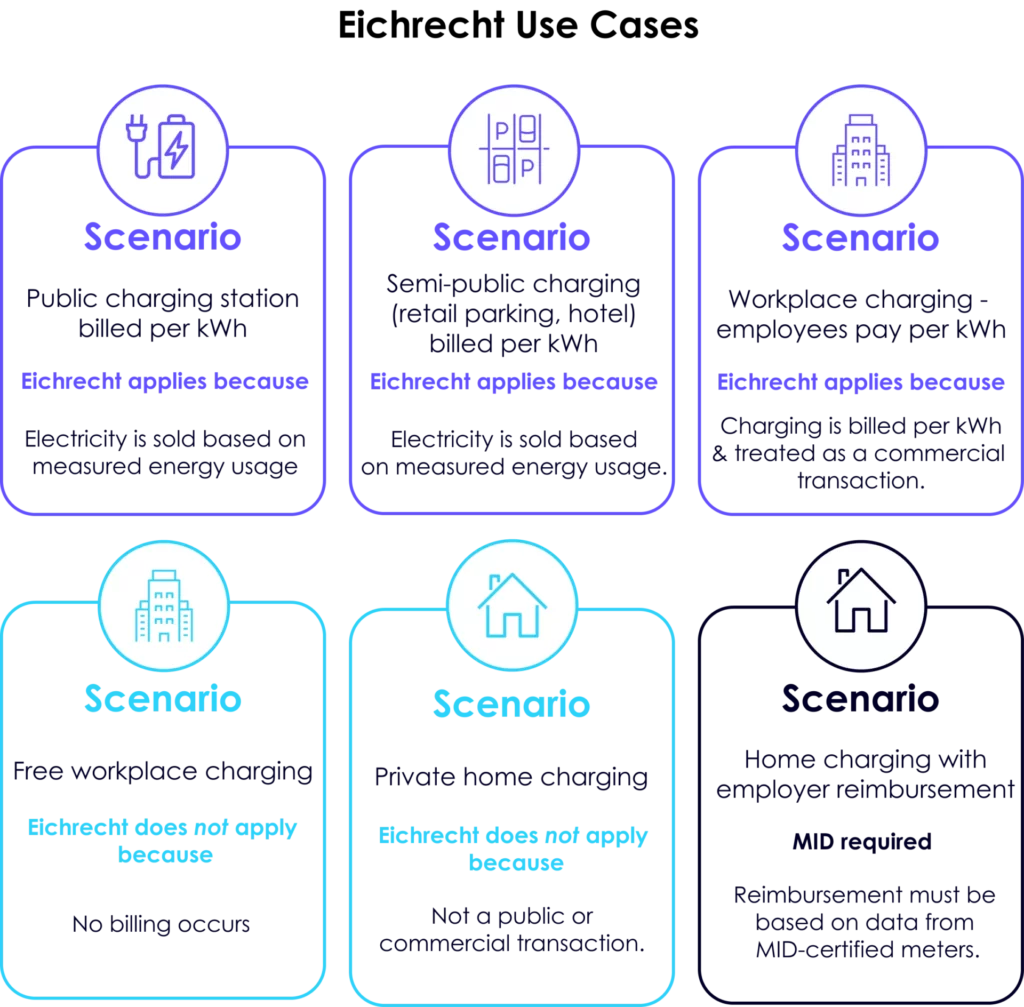
Eichrecht (Mess- und Eichgesetz) is Germany's measurement and calibration law, strictly regulating billing practices for EV charging in public and semi-public areas. According to the regulation, charging stations may not utilize time-based or flat-rate billing, but must instead calculate costs strictly based on the actual energy consumed (kWh).
While compliance is not mandatory for private home charging, Eichrecht enforces its standards on any public or semi-public chargers, as well as workplace charging requiring payment from employees or visitors due to the commercial nature of the transaction.
Differences between Eichrecht and MID Standards
When discussing billing compliance for EV chargers, both European MID standards and German Eichrecht are frequently mentioned. However, they significantly differ in execution:
1. EU's Foundational MID Framework
MID (Measuring Instruments Directive) is a broad regulatory framework applicable across all EU member states. It establishes foundational standards for the design and manufacture of measuring instruments, ensuring basic calibration and accuracy (such as a maximum error of 1% for active energy measurement). It requires meters to be accurately calibrated at the factory and securely sealed to prevent tampering.
2. Germany's Stringent Eichrecht Defense
Eichrecht is tailored specifically for the German market, emphasizing not only measurement accuracy but a high degree of transparency and verifiability for the consumer. Building upon the MID baseline, it mandates a unique public key infrastructure, digital signature functionality, and end-to-end data security. Therefore, a charging station being MID compliant does not automatically make it Eichrecht compliant.
Core Compliance Requirements of Eichrecht
To meet the strict Eichrecht standards, EV charging hardware and CPO back-end systems must fulfill the following core capabilities:
- Calibration and Type Approval: Meters and related hardware must undergo rigorous testing and receive type approval from institutions like Germany's National Metrology Institute (PTB), often marked by a specific conformity mark (e.g., DE-M mark).
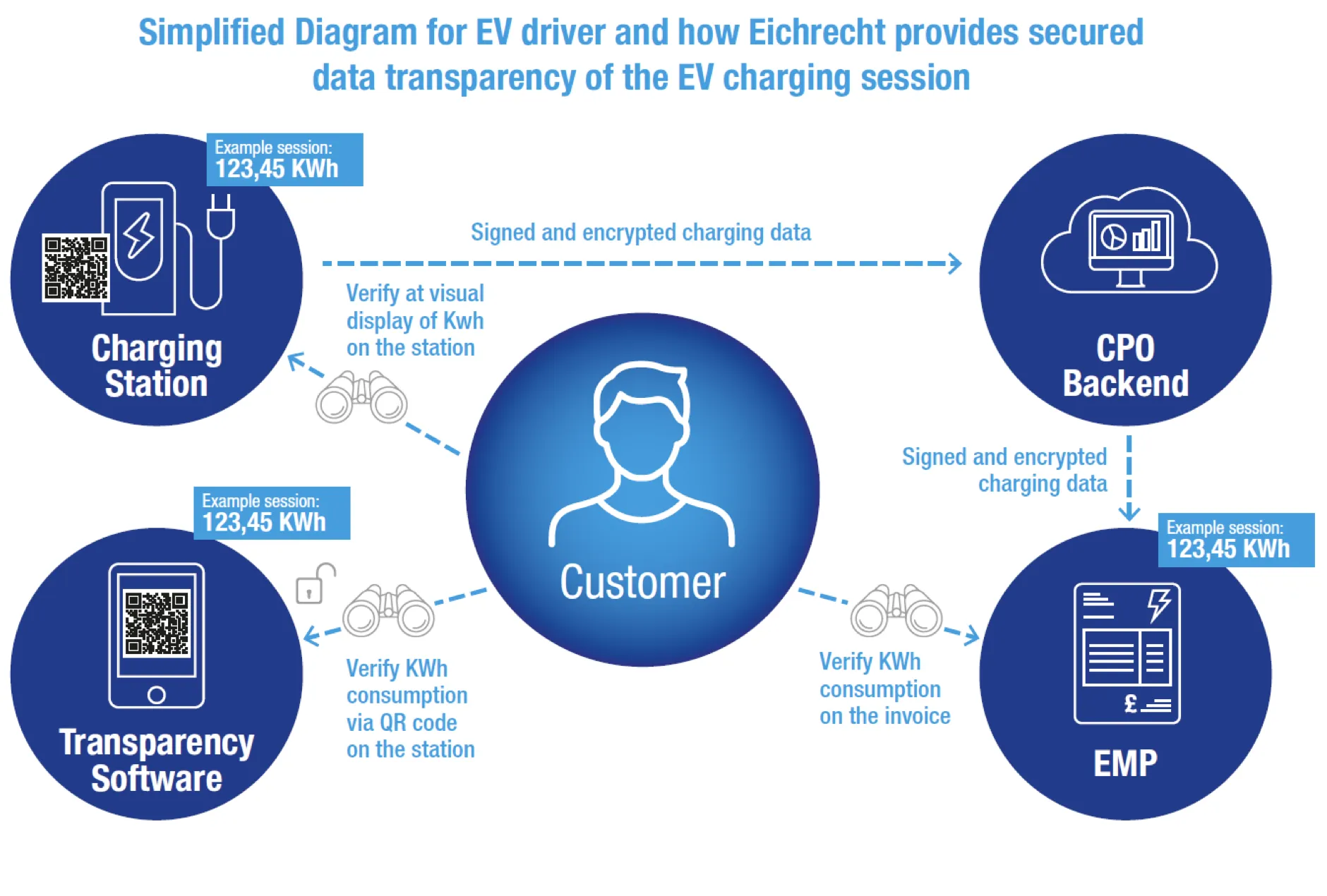
- Customer Visibility: The kilowatt-hour (kWh) reading must be directly visible to the customer. This requires a display integrated into the EVSE enclosure or a transparent viewing window to the physical meter itself.
- Digital Signatures and OCMF: Billing data must be securely signed at the charging station using an independent private key. This data is typically packaged in the OCMF (Open Charge Metering Format) to guarantee it remains tamper-proof during transmission to the backend.
- Verification via Transparency Software: Each charging station must provide a visible public key (such as a printed QR code or on-screen display). Consumers can use industry-standard "Transparency Software" to read the OCMF packets and independently verify the authenticity of the start and end values on their invoices.
Challenges and Barriers to Market Entry
Despite offering unparalleled consumer trust, Eichrecht imposes extremely high barriers for both network operators and hardware manufacturers. Success not only demands surviving lengthy PTB testing but requires building a robust, high-performance cryptographic system at the edge to handle public key infrastructure—a severe pain point for companies trying to enter the German market.
⚡️ Charge Stack Studio: Overcoming Stringent Eichrecht Architecture Barriers
Developing a PTB-approved public key system, handling OCMF data packaging, and integrating high-security data signatures limit many global charging brands seeking entry into Germany.
Charge Stack Studio provides robust architectural support for billing and edge communications. By integrating our Charge Bridge smart module, charging stations can rapidly process high-concurrency digital signatures and encrypted payloads. With our profound experience in protocol stack development, we can help your hardware meet Eichrecht specifications and secure your competitive edge in the demanding German market.
The Future Prospect of Eichrecht
As the global expansion of electric mobility accelerates, the need for exact measurement, transparent validation, and reliable standardization will only increase.
While currently specific to Germany, Eichrecht possesses the safety and privacy foundations to become a "blueprint" for worldwide EV charging standards. Complying with these high demands is not merely about achieving legal status; it is about guaranteeing long-term security, transparency, and a superior roaming experience for all EV drivers across interconnected networks globally.