Charge Stack Studio -ChargeBridge
Charge Bridge: The Ultimate SECC Module for ISO 15118 & OCPP Compliance
An Unprecedentedly Simple Experience
Solve vehicle communication challenges end-to-end: simply integrate our plug-and-play ChargeBridge to rapidly build your own EV charging controller.
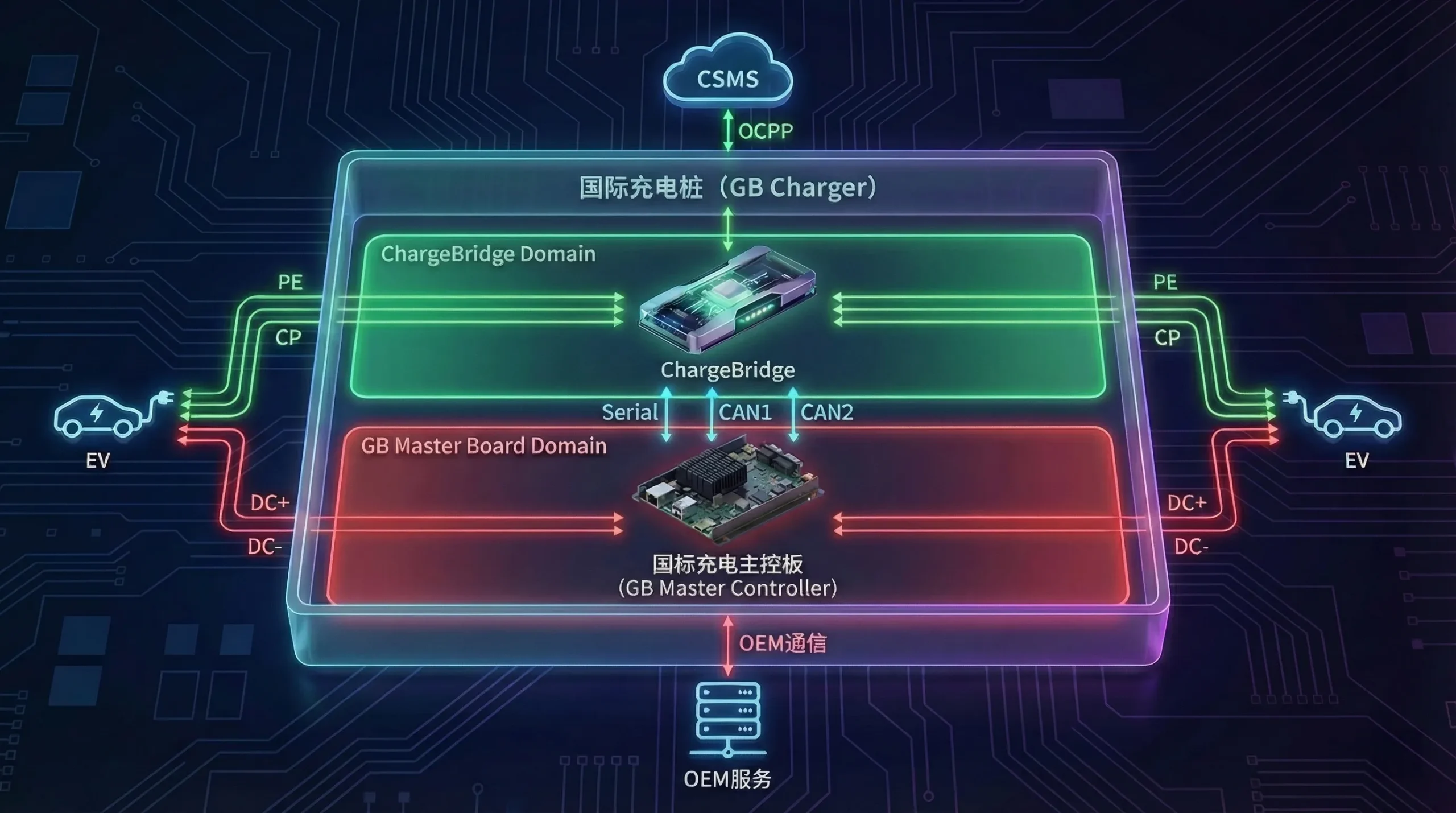
The ChargeBridge module delivers a secure, reliable, fast-to-certify, and highly flexible charging control solution.

Fully Master Mature Charging Logic
Our SoM firmware is deeply integrated with all key safety features to protect your product.

Make Controller Development Easier
Simplify the process and handle complex technical challenges with ease.

Zero Certification Risk
Helps you rapidly build cutting-edge, standard-compliant charging station controllers.

Easily Realize Custom Solutions
Simply rely on our off-the-shelf system to flexibly build your exclusive configuration.

Modular Design
With its modular and compact design, our pre-assembled ChargeBridge module supports flexible customization. Developers can easily meet specialized requirements and seamlessly integrate the control board into various EV charger designs.

Pre-installed Charging Firmware
Our ChargeBridge module comes with pre-installed firmware and lifetime updates, eliminating the need to develop complex software from scratch and significantly reducing development time and costs. Developers can move quickly from prototype to mass production, focusing on functional innovation and differentiation while relying on stable, compliant, and high-performance foundational software.
Pre-certified Solution
Pre-certified SoM firmware running on the MCU complies with all relevant industry standards. This enables developers to accelerate product development while reducing certification risks.

MCU-based Safety Mechanisms
MCU-managed safety mechanisms decouple and isolate safety functions and related certification functions in the circuit design, allowing the ChargeBridge module to support rapid development while ensuring compliance with industry safety standards.

Zero-threshold Ready-to-use Solution
Break through technical barriers with zero certification, zero development, and no need for specialized personnel. By providing complete reference designs and ready-to-use carrier boards with pre-certified firmware, manufacturers can focus on customizing core business logic and achieve rapid time-to-market.
Ecosystem Compatibility & Technical Support
The ChargeBridge module is compatible with various mainstream charging protocols and interface standards. We also provide professional technical support and detailed development documentation to help developers quickly resolve integration issues, accelerating the transition from proof-of-concept to mass production.
ChargeBridge Full-Stack Communication Architecture
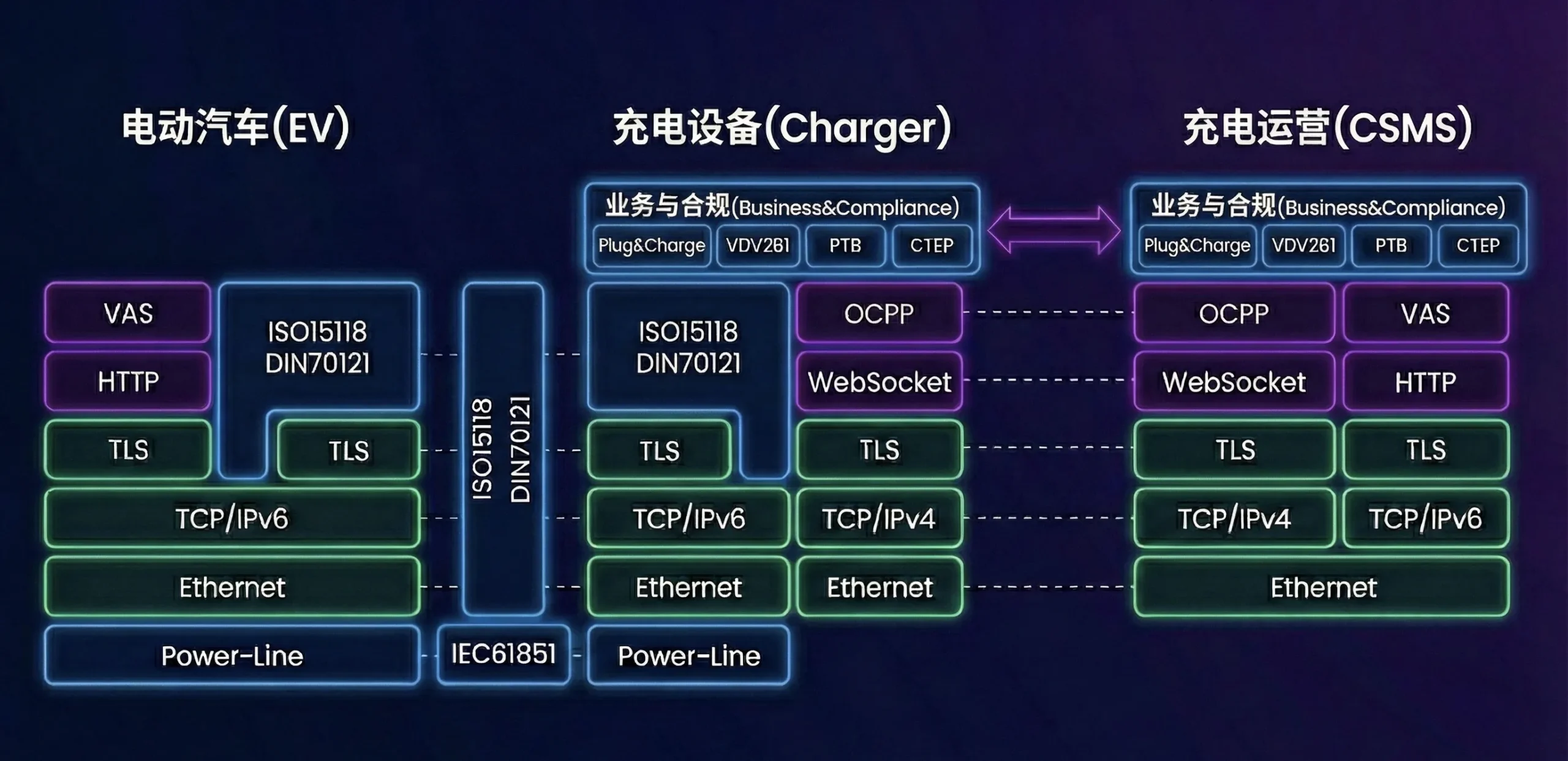
ISO 15118 Protocol Series - Support List
ISO 15118-1:2019
Vehicle to grid communication interface — Part 1: General information and use-case definition
ISO 15118-2:2014
Vehicle to grid communication interface — Part 2: Network and application protocol requirements
ISO 15118-3:2015
Vehicle to grid communication interface — Part 3: Physical and data link layer requirements
ISO 15118-4:2018
Vehicle to grid communication interface — Part 4: Network and application protocol conformance test
ISO 15118-5:2018
Vehicle to grid communication interface — Part 5: Physical layer and data link layer conformance test
ISO 15118-10:2022
Vehicle to grid communication interface — Part 10: Physical and data link layer requirements for single-pair Ethernet
ISO 15118-20:2022
Vehicle to grid communication interface — Part 20: 2nd generation network and application protocol requirements
DIN/IEC Protocol Series - Support List
DIN SPEC 70121:2014
Electromobility - Digital communication between a d.c. EV charging station and an electric vehicle for control of d.c. charging in the Combined Charging System.
IEC 61851-1
Electric vehicle conductive charging system — Part 1: General requirements
IEC 61851-23:2023
Electric vehicle conductive charging system — Part 23: DC electric vehicle charging station
IEC 61851-24:2014
Electric vehicle conductive charging system — Part 24: Digital communication between a DC EV charging station and an electric vehicle for control of DC charging
OCPP Protocol Series - Support List
OCPP 1.6 (J)
Open Charge Point Protocol 1.6 (JSON), currently the most widely used version globally, supporting basic smart charging and status reporting.
OCPP 1.6 Security Whitepaper
OCPP 1.6 Security Whitepaper, adding a critical security layer to version 1.6, defining Security Profiles including TLS encryption and basic authentication.
Using ISO 15118 Plug & Charge with OCPP 1.6
OCPP 1.6 Application Note for Plug & Charge, official guidance from OCA on tunneling ISO 15118 data within the OCPP 1.6 framework to implement Plug & Charge.
OCPP 2.0.1
Open Charge Point Protocol 2.0.1, the next-generation mainstream standard, featuring native ISO 15118 (PnC) support, advanced Device Management, and enhanced security.
OCPP 2.1
Open Charge Point Protocol 2.1, the latest evolution, focusing on DER (Distributed Energy Resources) and V2G (Vehicle-to-Grid) support, and refining ISO 15118-20 adaptation.
Advanced Features & Metering Certification - Support List
Plug & Charge (PnC)
Plug & Charge, based on ISO 15118, enabling automatic authentication and payment upon vehicle connection, eliminating the need for cards or QR codes.
VDV 261
Communication standard for pre-conditioning of electric buses, mainly used for auxiliary function control during charging (e.g., pre-heating air conditioning/battery).
Using ISO 15118 Plug & Charge with OCPP 1.6
OCPP 1.6 Application Note for Plug & Charge, official guidance from OCA on tunneling ISO 15118 data within the OCPP 1.6 framework to implement Plug & Charge.
CTEP/NTEP
California Type Evaluation Program (CTEP), a metering certification standard required by the California Department of Measurement Standards.
PTB Eichrecht
PTB Eichrecht certification (German Calibration Law), ensuring accurate metering, tamper-proof data, and traceability in compliance with German law.
FAQ
1How many charging connectors does one ChargeBridge module support?
One ChargeBridge module supports up to 2 charging connectors.
2What is the technical architecture of ChargeBridge?
ChargeBridge consists of two components. The first runs on a Linux System on Module (SoM) handling all "high-level" communication. The second handles core charging logic, or "low-level" communication. Since all safety-relevant code must execute quickly without latency and independently of Linux code, this is handled by ChargeBridge firmware embedded in a microcontroller. It can even charge cars (using PWM), though it lacks the complexity for smart charging apps. Only the perfect combination of these two ensures a safe, reliable charger while maintaining full functionality.
3Which charging standards does the ChargeBridge module support?
Designed for European and American markets, ChargeBridge covers protocols like CCS1/CCS2/NACS/MCS. Thanks to its standardized pin-compatible design, it offers great flexibility—you can swap hardware if the controller design permits. This means seamless switching between US and EU standards by simply replacing the ChargeBridge module (and cable), significantly reducing hardware costs for different markets.
4Which vehicle models has ChargeBridge been tested with?
Hyundai, Tesla, Citroen, OPEL, MG, Volkswagen, Fiat, MINI, BMW, Ford, Polestar, Chevrolet, Mercedes-Benz, Renault, BYD, Audi, KIA, Ora, MAXUS, Subaru, Genesis, Nissan, RIVIAN, Lucid, Cadillac, Volvo, XPENG, SKODA. Contact us for a detailed list.
5Which OCPP platforms has ChargeBridge been tested with?
Noodoe, Ampeco, EV connect, EOSVOLT, GreenBox, Eco-drive, Moovy, Monta, ampUp, etc. Contact us for a detailed list.
Contact Us
Learn more and let us help you efficiently deploy the future of EV charging.

