VDV 261 Explained: Defining the New Standard for Electric Bus Preconditioning and Smart Charging
2025年12月17日
Deep Dive into Eichrecht (German Calibration Law): Ensuring Transparent and Fair EV Charging
2026年3月12日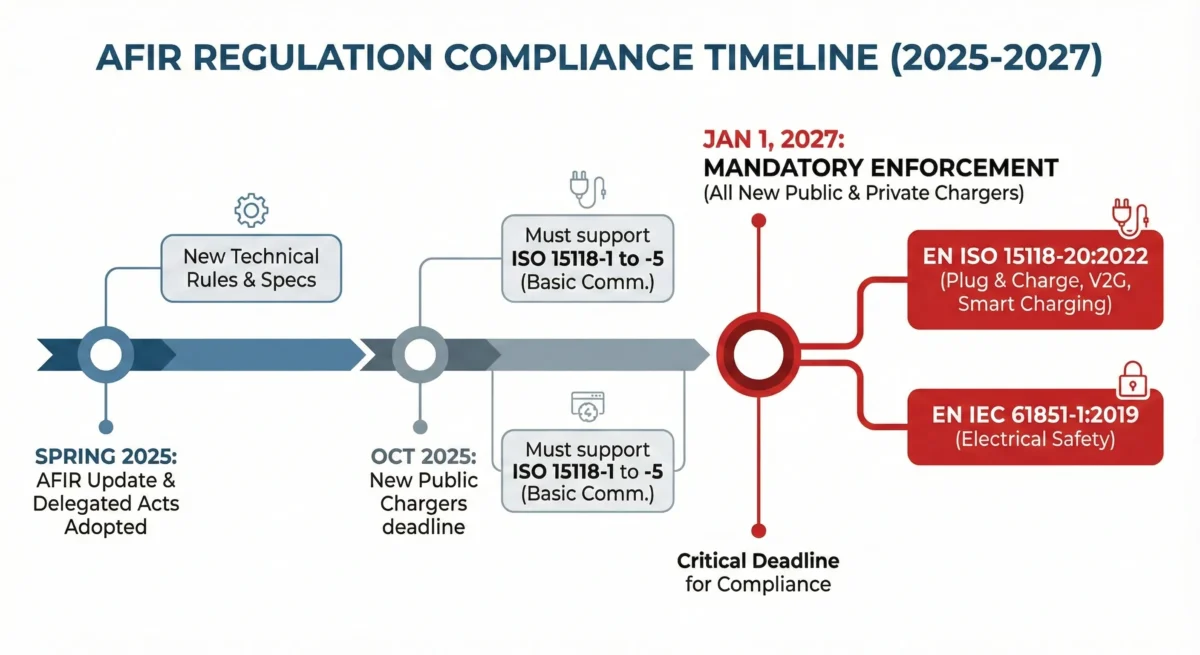
Mandatory by 2027! The Technical Overhaul and Survival Guide for the EV Charging Industry Under New AFIR Rules
With the Alternative Fuels Infrastructure Regulation (AFIR) now fully in effect, alongside the latest legislative package passed in Spring 2025, the EV charging industry is facing a rapid and mandatory transformation. These are no longer abstract goals for 2030; the countdown has begun, with less than 10 months until the critical compliance red line. These regulations will fundamentally disrupt the technical architecture of every new and refurbished charging station in the EU.
Here is a breakdown of what is changing, what it means for charger manufacturers, and how to effectively navigate this shift.
Background Check: What is AFIR?
AFIR (Regulation EU 2023/1804) sets a binding framework for deploying public electric vehicle charging and alternative fuel infrastructure across the EU. Its goals are crystal clear:
- Ensure interoperability and accessibility of charging stations.
- Standardize payment methods and price transparency.
- Enable smart charging and bi-directional grid integration.
- Create a seamless, pan-European network for EV drivers.
Currently, the regulation applies to all stations open to the public, and under specific conditions, semi-public and fleet-related deployments. The new kicker: starting January 2027, private Type 3 and Type 4 chargers will also fall under strict regulation.
The Spring 2025 AFIR update arrived as a comprehensive legislative package. Specifically, Delegated Act (EU) 2025/656 locked in the underlying technical and communication standards, while Implementing Regulation (EU) 2025/655 cemented the data transparency requirements. The real engineering challenge begins now.
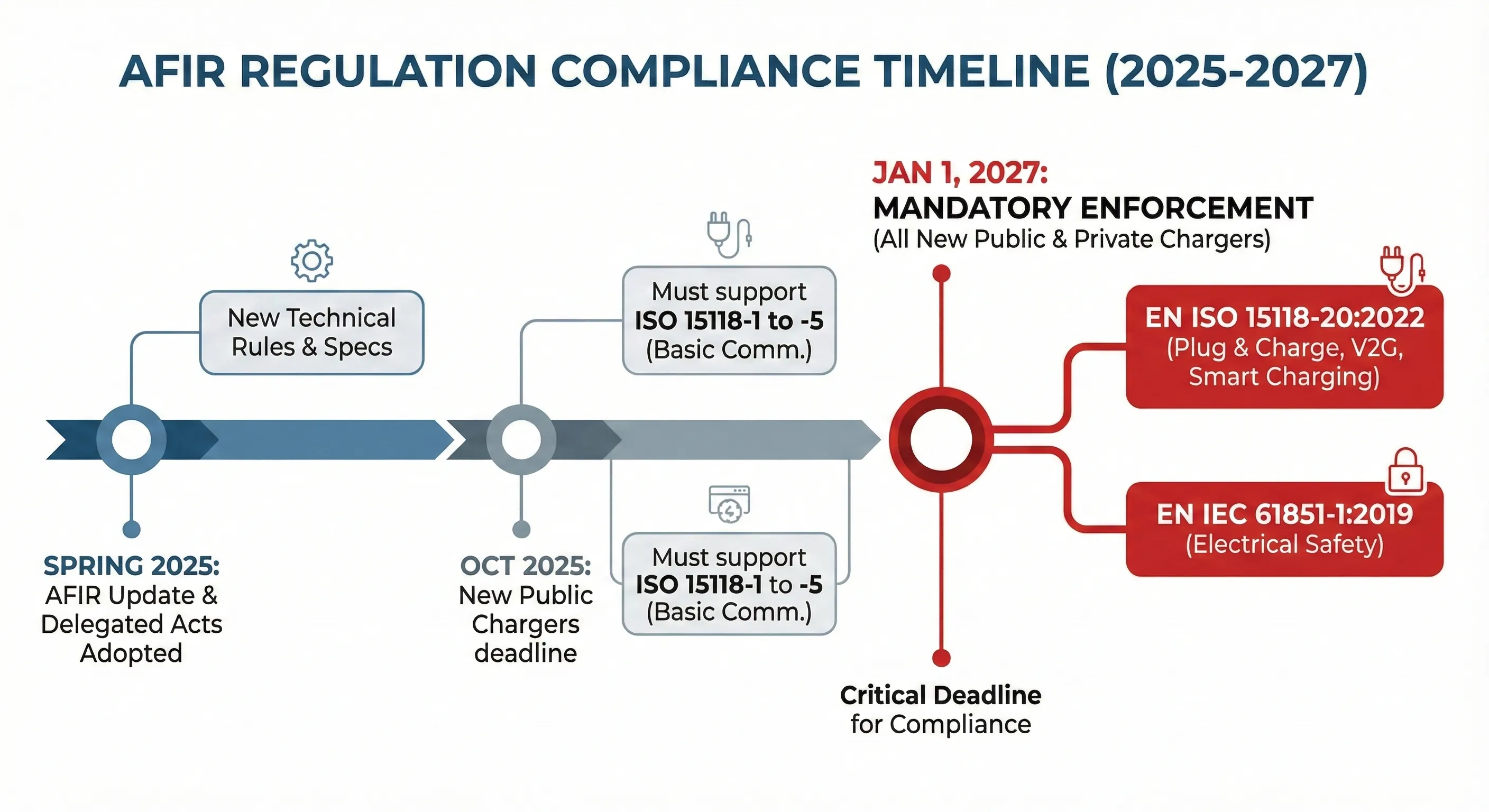 Figure 1: Key Compliance Timeline for AFIR Regulations (2025-2027)
The New Timeline: Less Than 10 Months to Re-architect
The key dates you need to internalize are:
🗓️ From October 2025:
All new or refurbished publicly accessible chargers must support ISO 15118-1 to -5.
🗓️ ALERT: Mandatory Enforcement starting January 1, 2027:
ALL new or refurbished public AND private chargers must support:
- EN ISO 15118-20:2022 (The version enabling Plug & Charge and bi-directional charging).
- EN IEC 61851-1:2019 for electrical safety.
If the charger offers Plug & Charge functionality, it must support both:
- ISO 15118-2:2016 AND ISO 15118-20:2022.
Furthermore, smart charging (and the capability for bi-directional energy transfer) is no longer optional—at least on the communication side. Every charger installed or renovated after January 1, 2027, must be ready for smart communication and deep system integration.
What This Really Means: A Massive Shift in Hardware & Software
Let’s break down the consequences into five critical dimensions:
1. Communication Protocols: ISO 15118-20 Takes the Lead
ISO 15118-20 isn't just "another version." It brings major architectural overhauls:
- Bi-directional charging (V2G) support.
- Enhanced security (Heavy certificate handling, TLS 1.3).
- More flexible Plug & Charge mechanisms.
- New use cases like Smart Energy Management.
- PLC modules for high-level vehicle communication.
- Computational headroom to support Secure Boot, TLS 1.3, and robust encryption.
- The most streamlined and future-proof approach is a powerful, Linux-based integrated hardware-software architecture like Charge Bridge!
2. Hardware Requirements: From Microcontrollers to Real Computers
To be AFIR compliant, future chargers must feature:
- PLC Modems for high-level communication (ISO 15118).
- Analog safety AFE circuits compliant with IEC 61851-1.
- Microcontrollers (MCU) dedicated to real-time, safety-critical logic.
- Processors (Linux-based) handling heavy application logic and secure communications.
- Displays on public chargers for strict pricing transparency.
3. Payment Terminals, Screens & Absolute Transparency
AFIR mandates strict pricing transparency and ad-hoc payment support, making a clear distinction based on capacity and public accessibility:
- ✅ Full Terminals Required (≥ 50 kW & Publicly Accessible): Must feature physical displays clearly showing the price per kWh. Any occupancy fees (per minute) or session fees must be shown clearly before a charging session begins. They are also mandated to support contactless debit/credit card payments or NFC. (Note: Existing ≥ 50 kW public chargers must be retrofitted to comply by 2027).
- ✅ Basic Transparency (< 50 kW AC Chargers): Ad-hoc payments without a pre-registered contract can be facilitated via a secure QR code or mobile app. The price per kWh and any other fees must still be transparent, but physical card readers and large billing screens are not strictly mandated.
- ❌ Exemptions (Private or Restricted Access): Fleet depots, private workplace parking, or sites entirely restricted to pre-existing contract payments.
📌 Crucial Note: If general access to supermarket chargers or semi-public sites is not restricted, they are classified as public facilities under AFIR and must strictly meet these transparency standards.
4. Cybersecurity & Compliance: No Longer Just Charging
AFIR now aligns tightly with other regulatory frameworks like the Cyber Resilience Act (CRA), NIS2, and GDPR. This means:
- Encrypted firmware updates are mandatory.
- System access must be protected via certified Secure Elements.
- Secure Boot and TPM are required for cryptographic operations and firmware integrity.
- Roaming, cloud services, and payment interfaces must never leak personal data.
This is the first time EU-wide cybersecurity standards directly dictate the architecture of EVSE firmware, bootloaders, and remote maintenance logic.
5. Ready to Ship: Testing & Certification for ISO 15118-20
With hundreds of new EV models expected by 2027, ad-hoc testing can no longer guarantee compatibility. The future lies in:
- Automated testing tools and simulators.
- Formal certification paths for ISO 15118 and OCPP.
- Cloud-based CI/CD pipelines for EVSE firmware.
The Triple Squeeze: Cost, Time, and Complexity
The industry is facing a perfect storm:
- Severely compressed development cycles (with less than 10 months to the hard deadline, building from scratch is no longer viable).
- Spiraling R&D and testing costs.
- Severe margin pressure in a highly competitive hardware market.
Even highly experienced EV charger manufacturers are struggling to rapidly overhaul their underlying systems to maintain an early-mover advantage without sacrificing quality.
The Solution: Charge Bridge — The Compliance-Ready Core Module
Charge Stack Studio engineered the Charge Bridge core module specifically to break this deadlock.
As a highly integrated, enterprise-grade solution, Charge Bridge flawlessly handles the technical overload brought on by AFIR:
- Architectural Superiority: Utilizes a standardized Linux + MCU dual-core architecture, completely eliminating the bottleneck of traditional microcontrollers that fail to handle complex certificate processing and TLS 1.3 encryption.
- Full Protocol Stack: Ships with out-of-the-box support for ISO 15118-2/20 (Plug & Charge Ready), plus full versions of OCPP 1.6/2.0.1/2.1, eliminating cross-border interoperability anxiety.
- Security First: Built-in Secure Boot, TLS 1.3 encryption, and a continuous vulnerability management pipeline to fully comply with CRA and NIS2 requirements.
- Rapid Global Deployment: Provides a comprehensive docking SDK, allowing manufacturers to retrofit existing baseline chargers (e.g., GB/T or basic EU models) in just 2-4 weeks, drastically accelerating time-to-market.
The Charge Bridge Hardware Module goes further as an enterprise-grade foundation:
- Ruggedized for commercial deployment and designed for harsh operational environments.
- Ready to seamlessly integrate displays, TPM modules, and payment terminals to meet AFIR's strict display requirements for ≥ 50 kW public chargers.
- Currently deployed by global OEMs and certification labs for real-world interoperability testing.
- Pre-certified Foundation: Backed by automated testing and pre-certification, empowering you to deliver compliant products without needing to build a massive low-level protocol R&D team from scratch.
By embracing Charge Bridge, you instantly de-risk your technology stack, cut deployment times, and stay perfectly synchronized with where AFIR—and the entire EU market—expects you to be in 2027 and beyond.
Conclusion: The Future of Charging is Regulated, Secure, and Interoperable
Whether you are a charger OEM, a CPO, or a software provider, AFIR is no longer a future concern—it is today's engineering blueprint.
Early adapters will capture immense market share. Those who hesitate risk being entirely locked out of the next wave of EV infrastructure funding, lucrative tenders, and key partnerships.
There is still time to pivot, but the window is closing.
By adopting these standards now, we aren't just meeting an immediate requirement; we are building the foundation for what comes next: tighter regulation of critical infrastructure, and a smart, secure, and truly interoperable electric mobility ecosystem.
Ready to cross the AFIR compliance red line and future-proof your global charging platform?
Contact Charge Stack Studio to discuss standard specifications, software stack architecture, and how the Charge Bridge module can help you deliver AFIR-compliant smart chargers at unprecedented speed.
📚 Further Reading & References
- AFIR Regulation (EU) 2023/1804 – Full Legal Text:
EUR-Lex: CELEX 32023R1804 - AFIR Regulation (EU) 2023/1804 - Annex II:
Regulation - 2023/1804 - EN - EUR-Lex - Overview of Delegated Acts Adopted April 2025 – Data & Interoperability:
European Commission Announcement - Common Technical Requirements for AFIR Data Exchange (Delegated Act); Commission Implementing Regulation (EU) 2025/655 - Specifications and procedures for the availability and accessibility of data on alternative fuels infrastructure:
Data accessibility (EU) 2025/655 - NEVI (National Electric Vehicle Infrastructure) Requirements – USA:
INDOT – Appendix B: NEVI Requirements - Why CRA Needs TPM and Secure Boot:
Enhancing Security in ISO 15118-20 EV Charging Systems - ScienceDirect